

Elevate Controls offers full-cycle development of embedded controllers. Our consistent development process adapts to the unique requirements of your project and ensures a quality outcome every time. We use industry standard tool chains that ensure efficient use of resources, and design protect to allow for future variation and scalability.
Background
The TiRO process is a new process for producing titanium metal. The traditional Kroll process is an energy-intensive batch process that produces bulk metal that must be melted and cast to create Titanium parts. Each cycle of melting and casting degrades a proportion of the titanium stock to unusable nitrides, which are lost to the process cycle.
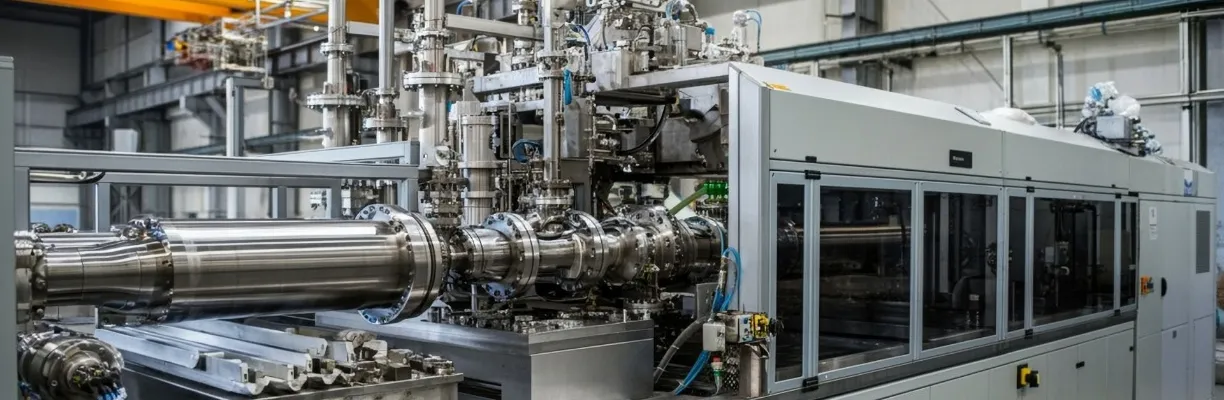
TiRO is an advanced continuous feed process that uses a fluidised bed reactor and vacuum sublimation chamber to produce Titanium powder under an Argon atmosphere. The powder can be processed directly into titanium parts using standard powder metallurgy techniques with no loss of product to the processing cycle.
TiRO was initially developed by CSIRO and commercialised in partnership with Coogee Chemicals. The first step in this partnership was to migrate the lab-bench prototype to a multi-function pilot scale plant capable of producing product in commercially usable quantities.
The Challenge
The pilot plant had three objectives:
- To continue to perform basic research on the TiRO process.
- To test commercial-scale implementations of advanced manufacturing equipment and techniques.
- To run as a 24/7 production facility capable of producing high-quality products in quantities suitable to supply to target customers
TiRO had to address the different, and often opposing, needs of two major stakeholder groups:
- The research scientists and engineers that are investigating the process. This R&D function demands that the plant be flexible and easily reconfigured to meet changing R&D and test requirements. Operators need to access and modify the system configuration as required.
- The process engineers that are charged with running a controlled commercial facility. The plant must be industrially robust and meet all appropriate workplace standards and engineering certifications, with an emphasis on safe, reliable, and predictable operation. Operationally, this means that system stability is prioritised over variation, and operators are typically isolated from changing, or even accessing, the low-level functionality of the system.
An additional technical challenge was maintaining the highly exothermic fluidised bed reaction within a narrow temperature range just below the 1,668 °C melting point of titanium metal. This required a dense network of high-speed temperature sensors feeding data to custom real-time control logic algorithms.
The Solution
Elevate Controls implemented a high-speed deterministic control system based on NI CompactRIO Programmable Automation Controllers and NI LabVIEW Real-Time and FPGA software that deliver low-latency precision control of the thermal, pressure, and motion subsystems.
The system included:
- 12 distributed IO Chasses/Controllers,
- Over 400 analog, digital, and motion IO points, and a mix of conventional PID and custom control logic.
It met the needs of both the research scientists for flexible data acquisition, data processing & control, and the process engineers for safe, robust 24/7 operation.
High-level NI software modules and frameworks ensured that software changes were implemented safely, robustly, and repeatably.
An extensive R&D program was executed in parallel with 24/7 production of high-quality titanium powder product for regular delivery to major customers worldwide.
The Outcome
The system was deployed on-time and on-budget. Its active lifetime was originally projected to be 1-2 years. However, it has remained in continuous operation for over 10 years, including relocation to a major new facility with a 50x increase in production volume.
This project was recognised as a Finalist at the PACE Zenith Awards 2013 in theMining, Minerals, and Exploration category.